


Hardware components | ||||||
| × | 1 | ||||
Software apps and online services | ||||||
 |
| |||||
Brainiak is the decision brain (ZTTM).It is designed for:
- Decision sovereignty outside the LLM.
- Stateful runtime with bounded active context.
- Verifiable transitions through receipts.
- Memory that becomes actionable, not just textual.
Brainiak_Q is the governed LLM runtime layer on top of Brainiak.“Q” refers to Qwen 3.5 27B (+ LoRA adapters via vLLM).
Role split:
- Brainiak/ZTTM decides.
- ToolHub executes.
- Brainiak_Q orchestrates governed runtime projection.
- The LLM verbalizes and reformulates, but does not decide.
Brainiak is defined by strict invariants:
- The LLM does not decide.
- The frontend does not carry decision context.
- Tools are not “intelligent.”
- ToolHub executes but does not arbitrate.
- ZTTM remains the decision authority.
- Every action emits a receipt.
- Receipts feed live memory.
- Memory becomes operational (affordance-generating), not only conversational.
Brainiak runs this loop:
perception -> ZTTM decision -> ToolHub action -> receipt -> live memory -> affordance -> next ZTTM decision -> next action
This is fundamentally different from:
conversation history -> LLM answer
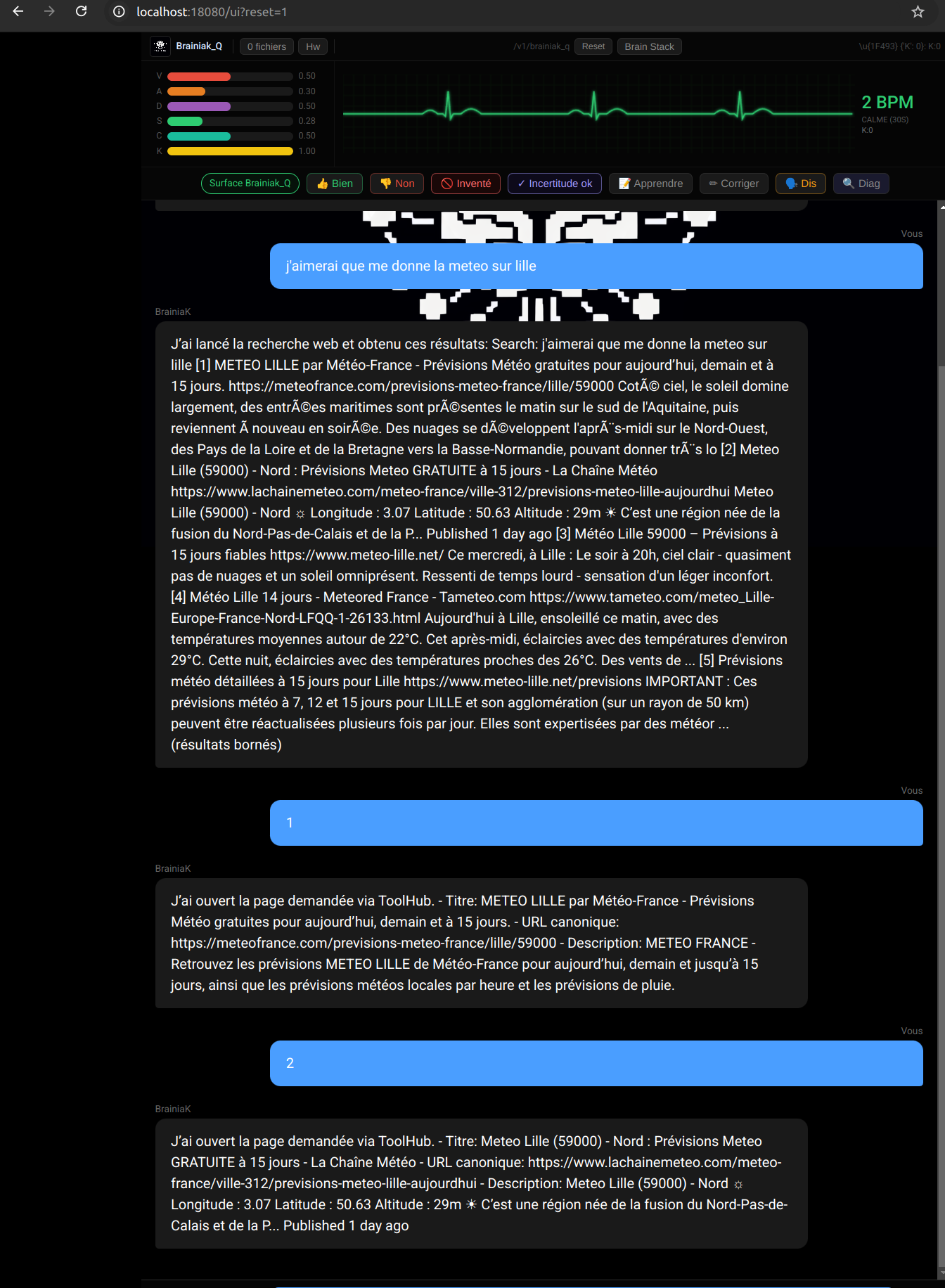
4. Minimal proof: “weather in Lille” -> “the 1”The scenario is intentionally simple.
Turn 1- User asks for weather in Lille.
- ZTTM selects
web_search. - ToolHub executes.
- System emits a verifiable indexed receipt (
[1],[2],...). - Receipt is written into live memory (
memory_w,LoRA_context_layer,dynamic_knowledge_payload).
- User says only: “the 1”.
- ZTTM resolves this pointer from prior receipt state.
- ZTTM selects
http_request. - ToolHub executes and emits a second clean receipt (title, canonical URL, description).
Expected diagnostics in this flow:
llm_used=falseon action decision in turn 2.- Route trace consistent with receipt-driven decision flow (for example:
brainiak_q_zttm_toolhub_receipt).
Why this is a big deal:The UI interaction is tiny, but the architecture signal is huge:a prior event is transformed into next executable intent without LLM arbitration.
5. Why this is not just RAG or classic tool-callingRAGRetrieves context to improve text generation.
Classic tool-calling agentsOften let the LLM decide tool routing.
Chat-history botsMostly replay textual context.
BrainiakUses receipts as operational state:
- Action result -> receipt.
- Receipt -> affordance.
- Affordance -> next ZTTM decision.
- ToolHub executes under explicit decision authority.
Brainiak does not claim infinite token context in one window.
It uses:
- Bounded active runtime state (sliding discipline).
- Persistent memory layers (Postgres/Qdrant via
memory_w). - Controlled reprojection into live operational context.
So the right framing is:bounded runtime, extensible memory horizon.
7. CPU-first, on-prem, traceableBrainiak is built around CPU-first conceptual/topological inference in the decision core.The LLM is integrated as a governed effect layer.
Practical consequences:
- Better control over system behavior.
- Explicit separation of decision/execution/verbalization.
- Natural on-prem deployment posture.
- Auditable action transitions through receipts.
- A validated receipt-mediated operational memory loop.
- Decision sovereignty outside the LLM in the demonstrated flow.
- End-to-end auditable transitions.
- No AGI claim.
- No universal “zero hallucination” claim across all tasks.
- No “first in the world” absolute claim.
The strong, defensible claim is architectural:Brainiak changes control topology, not just model size.
9. Screenshots to include (evidence pack)For credibility, include these images in your Hackster post:
- Turn 1 user query (“weather in Lille”).
- Tool selection (
web_search) trace. - Receipt #1 with indexed results.
- Live memory write/projection evidence.
- Turn 2 input: “the 1”.
- Decision diagnostics (
llm_used=falsefor action arbitration). http_requestexecution trace.- Receipt #2 with canonicalized output.
- Architecture diagram: Brainiak -> Brainiak_Q -> ToolHub -> receipts -> memory -> affordances.
Important: redact secrets, tokens, private hostnames, and sensitive infra details.
10. Theoretical foundation (arXiv preprints)A General Equilibrium Theory of Orchestrated AI Agent Systemshttps://arxiv.org/abs/2602.21255
- A General Equilibrium Theory of Orchestrated AI Agent Systemshttps://arxiv.org/abs/2602.21255
Agentic Hives: Equilibrium, Indeterminacy, and Endogenous Cycles in Self-Organizing Multi-Agent Systemshttps://arxiv.org/abs/2603.00130
- Agentic Hives: Equilibrium, Indeterminacy, and Endogenous Cycles in Self-Organizing Multi-Agent Systemshttps://arxiv.org/abs/2603.00130
Fractal Algebraic Topology of Semantic Computation. A Peer-Review-Oriented Formalization of the SSTD/Brainiak Concept Bundlehttps://arxiv.org/abs/2606.24240
- Fractal Algebraic Topology of Semantic Computation. A Peer-Review-Oriented Formalization of the SSTD/Brainiak Concept Bundlehttps://arxiv.org/abs/2606.24240
Brainiak is not “a bigger LLM.”It is a different architecture class:
- Topological decision core (ZTTM).
- Tool execution under explicit authority (ToolHub).
- Receipt-driven operational memory.
- Governed LLM runtime (Brainiak_Q) for effect and verbalization.
The “the 1” demo looks small from a user perspective.Architecturally, it demonstrates a major transition: from passive history to quasi_infinite actionable memory


Comments